
These ultra-small metal components—referred to by the customer as medical blades—are used in high-precision medical devices where reliability, sharpness, and dimensional accuracy are critical.
Manufactured using Wire-EDM (slow-wire electrical discharge machining), each blade maintains extremely tight tolerances and consistent geometry, enabling stable performance in surgical or micro-mechanical applications.
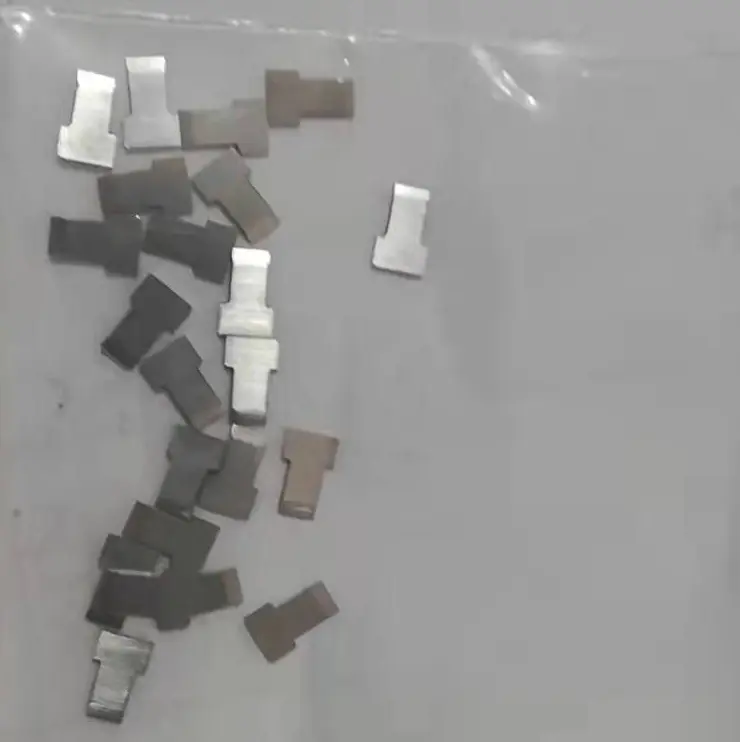
These micro blades typically serve as:
Cutting or shearing elements inside minimally invasive medical instruments
Micro-mechanical actuators in disposable surgical tools
Precision engagement tabs or locking blades within medical device assemblies
Functional micro-knife structures for controlled incisions or micro-tearing operations
- Why Wire-EDM Is Ideal for Medical Micro Blades
Medical micro blades require:
Sharp geometric transitions
High dimensional repeatability
Burr-free edges
Material integrity with no deformation
Wire-EDM provides:
Non-contact cutting — No mechanical stress
The blade shape is generated without any physical tool pressure, ensuring:
No bending
No micro-cracks
No edge deformation
This is essential for surgical-grade components.
Excellent consistency in high-volume production
Wire-EDM guarantees dimensional repeatability even for thousands of identical micro blades.
Ability to cut very small internal radii and sharp corners
The structure of these blades contains:
Narrow steps
T-shaped locking features
Sharp internal transitions
These features cannot be milled reliably due to tool size limitations, but are straightforward for EDM.
Superior surface quality and edge sharpness
The EDM finishing process creates smooth, uniform surfaces suitable for medical use.
- Key Advantages of Our Manufacturing Approach
Millimeter accuracy
Each blade is produced with tolerances down to ±0.003 mm, ensuring consistent fit and cutting performance.
Support for high-strength medical alloys
We routinely process:
Stainless steels (304, 316L)
Titanium alloys
Tungsten, Molybdenum
Cobalt-chromium alloys
These materials are widely used in medical device manufacturing due to their strength and biocompatibility.
Zero deformation + High structural integrity
Since EDM is a cold-cutting process, the finished blades maintain:
Material hardness
Flatness
Structural stability
Scalable production
The micro blades in the picture demonstrate the ability to manufacture:
Very small parts
High part counts per batch
Consistent yield for mass production
This allows developers of medical devices to move from R&D samples to full-scale production without changing processes.
- Common Applications in the Medical Industry
These micro blades are widely used in:
Minimally invasive surgical instruments
Micro-cutting assemblies inside diagnostic devices
Micro-scissors, micro-shearing tools, and micro-knives
Fluid control mechanisms in disposable medical cartridges
Precision engagement mechanisms inside handheld medical tools
Their small size, sharp geometry, and high precision make them ideal for modern medical tools where device miniaturization is essential.
- Engineering Challenges & How We Solve Them
Challenge 1 — Parts are extremely small (2–5 mm)
Small size makes them prone to:
Handling damage
Edge chipping
Dimensional drift
Our solution:
Custom fixtures + vacuum positioning + micro-batch handling techniques.
Challenge 2 — T-shaped geometry with sharp steps
This structure is difficult to mill or laser-cut.
Our solution:
Wire-EDM cutter paths optimized to maintain:
Sharp internal corners
Parallelism
Step uniformity
High edge definition
Challenge 3 — Material hardness varies by medical alloy
Some materials (e.g., tungsten, Co-Cr) are extremely difficult to machine.
Our solution:
Multi-pass EDM cutting + optimized discharge parameters to ensure clean surfaces without micro-cracks.
Challenge 4 — Burr-free edges required
Medical components cannot have burrs due to functional and safety concerns.
Our solution:
EDM finishing passes + optional micro-deburring + ultrasonic cleaning.