
In the realm of sub-millimeter wave technology, the Horn Antenna remains the gold standard for bridging the gap between guided waves and free-space propagation. As we push further into the Terahertz (THz) spectrum (0.1 THz to 10 THz), the demands on design precision and manufacturing tolerances become unforgiving.
For engineers and researchers, selecting the right horn geometry is a critical decision that balances gain, beam symmetry, and cross-polarization levels. Below is a professional breakdown of the three primary types of THz horn antennas.
Conical Horn Antennas: The Foundation of Simplicity
Conical horns are perhaps the most straightforward evolution from a circular waveguide. They are widely used as feed horns for CASSEGRAIN reflectors and in basic THz sensing setups.
Design Characteristics: A smooth transition from a circular waveguide to a flared circular aperture.
Performance: They offer moderate gain and are relatively easy to design. However, they suffer from inherent phase error across the aperture and uneven E-plane and H-plane beamwidths.
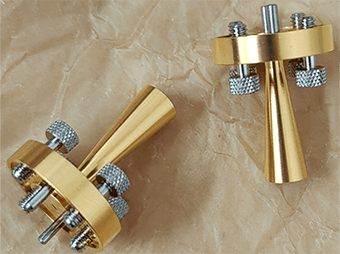
Manufacturing Advantage: At THz frequencies, conical horns are favored for their ease of fabrication via high-precision CNC turning or diamond turning, ensuring the internal surface roughness Ra is kept to a minimum—crucial for reducing ohmic losses.
Pyramidal Horn Antennas: The Workhorse of Gain
When high directivity is required from a rectangular waveguide source, the Pyramidal Horn is the industry standard. This antenna flares in both the E-plane and H-plane, forming a rectangular pyramid.
Design Characteristics: Flared from a rectangular waveguide (e.g., WR-3.4 for 220–330 GHz).
Performance: Pyramidal horns provide high gain and a very predictable radiation pattern. They are the “standard gain horns” used for calibrating THz measurement systems.
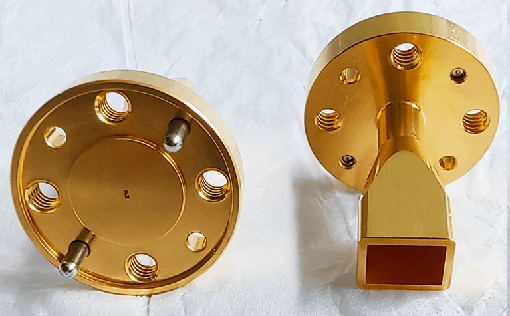
The THz Challenge: The “sharp corners” requirement. In the THz range, even a small radius in the internal corners can lead to mode conversion and performance degradation. Achieving a true sharp corner (R=0) via traditional milling is nearly impossible, often requiring specialized split-block machining or electroforming techniques.
Corrugated Horn Antennas: The Precision Benchmark
For high-performance satellite communications, radio astronomy, and complex THz imaging, the Corrugated Horn (often called the Scalar Horn) is unmatched.
Design Characteristics: The internal walls feature a series of grooves (corrugations) that are typically λ/4 deep. These grooves act as high-impedance surfaces.
Performance:
Beam Symmetry: Nearly identical E-plane and H-plane patterns.
Ultra-low Cross-Polarization: Essential for dual-polarization systems.
High Gaussian Efficiency: Making them ideal as feeds for quasi-optical systems.
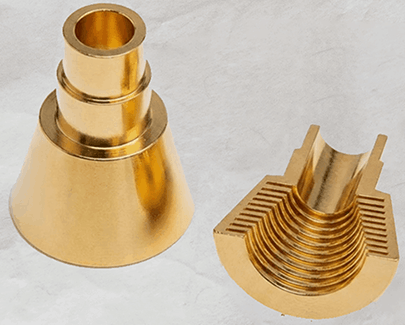
The Manufacturing Frontier: These are the most difficult to produce. In the Terahertz band, these corrugations become microscopic. Standard CNC cannot reach inside a small THz horn to cut these grooves. This is where specialized THz precision machining expertise shines—utilizing advanced EDM or specialized split-block designs to maintain sub-micron tolerances.
Comparative Summary for Terahertz Applications
| Feature | Conical Horn | Pyramidal Horn | Corrugated Horn |
| Aperture Shape | Circular | Rectangular | Circular |
| Beam Symmetry | Poor | Moderate | Excellent |
| Cross-Polarization | High | Moderate | Very Low |
| Complexity | Low | Medium | High |
| Best Use Case | Basic Lab Testing | Standard Gain Calibration | High-End Imaging/Telecom |
Why Precision Machining is the “Secret Sauce” in THz Horns(Featuring THZ Precision Engineering Capabilities)
In the THz regime, the wavelength (λ) is so small that surface finish and dimensional tolerance are no longer just “good practice”—they are the determinants of success.
Surface Roughness Ra: At 300 GHz and above, the skin depth of the signal is extremely shallow. Internal wall roughness causes signal scattering and massive insertion loss.
Alignment & Split-Block Precision: In split-block horn designs, even a 5um misalignment between halves induces severe phase errors.
Micro-Corner Integrity: Maintaining near-zero radius corners in pyramidal horns prevents higher-order mode distortion.
How THZ Precision Delivers
At THZ Precision, we bridge the gap between complex electromagnetic designs and physical reality. We specialize in high-precision machining and custom manufacturing for microwave, millimeter-wave, and terahertz components.
Our complete product line covers standard gain horns, custom conical, pyramidal, and corrugated horn antennas across WR-90 to WR-1.0 waveguide bands, operating seamlessly from 18 GHz up to 1.1 THz (1100 GHz).
By leveraging ultra-precision CNC split-block machining, micro-EDM, and stringent surface treatment protocols (Ra optimization), THZ Precision ensures that every antenna delivers optimal gain, minimal return loss, and precise beam patterns.
Partner with THZ Precision for Your High-Frequency
SolutionsWhether you are building a 100 GHz automotive radar testbed, a 300 GHz 6G wireless test setup, or a 1.1 THz sub-millimeter spectrometer, selecting the right horn antenna and manufacturing partner defines your system’s total efficiency.
Looking for a reliable manufacturing and component partner for your RF, microwave, and terahertz projects?
Explore THZ Precision’s full portfolio of WR-90 to WR-1.0 horn antennas (18 GHz – 1100 GHz) or contact our engineering team today to discuss your custom specifications.