
In millimeter-wave systems, the performance of a 24.125 GHz slotted waveguide antenna depends not only on electromagnetic design, but also on the precision of fabrication. At THz Precision, we focus on high-tolerance machining of WR-34 slotted waveguide antennas, helping translate RF design intent into stable, repeatable hardware performance.
The Machining Challenge: WR-34 & 24.125 GHz
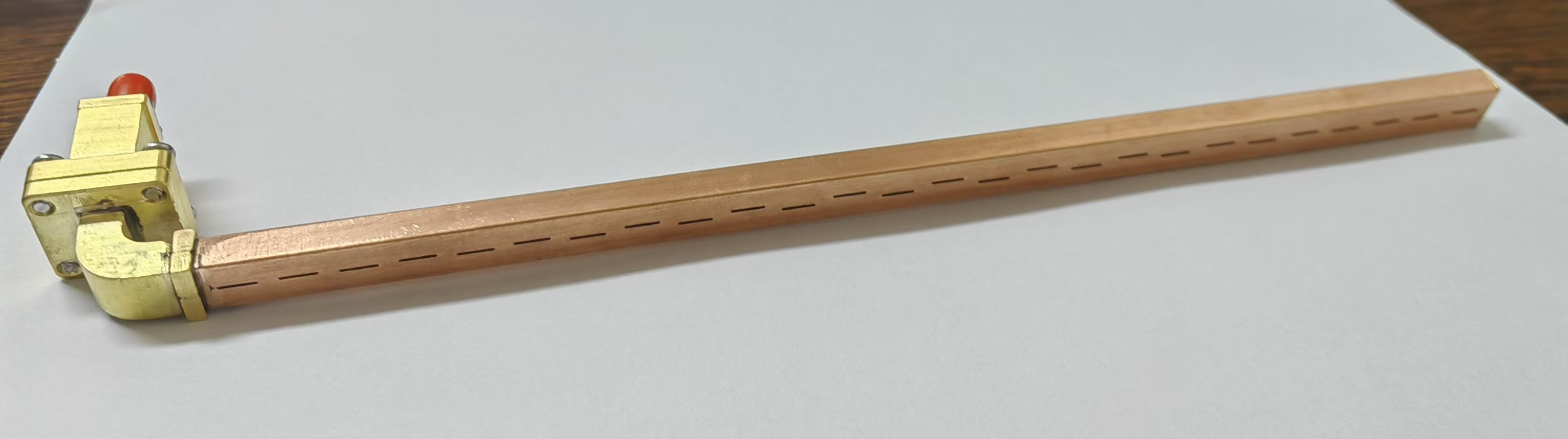
Operating at 24.125 GHz in the K-band, a WR-34 waveguide features compact internal dimensions of 8.636 mm × 4.318 mm. At this frequency, slot geometry, slot position, and waveguide dimensional consistency directly affect impedance behavior, phase distribution, gain, and radiation pattern stability. Even small machining deviations can degrade antenna performance.
Our Core Manufacturing Process
1. Premium Material Selection: H96 Brass
We use H96 brass for selected WR-34 antenna structures where machinability, dimensional stability, and manufacturing consistency are critical.
Good machinability for precise slot formation
Clean edge definition during CNC milling
Reduced burr formation for high-frequency structures
Ultra-Precision CNC Milling
Our CNC machining process is built for high-frequency waveguide components requiring tight dimensional control.
Precise control of slot length, offset, pitch, and alignment
Tight tolerance management for the waveguide body and flange interface
Controlled internal surface finish to reduce conductor loss at high frequencies
For slotted waveguide antennas, the machining objective is not simply cosmetic precision, but geometric consistency that supports predictable RF performance.
3. End Structure and Assembly Integrity
The end structure of the antenna is manufactured and assembled according to the intended RF design requirements.
Stable mechanical joining
Reliable dimensional control at the end section
Preservation of the intended RF boundary condition of the antenna design
This is especially important for waveguide slot arrays, where small structural inconsistencies can influence current distribution and radiation behavior.
4.Surface Treatment and Durability
After machining, the antenna can receive appropriate surface treatment for environmental protection and long-term stability.
Improved resistance to oxidation and discoloration
Better surface durability for practical deployment environments
Stable conductive condition for long-term use
Quality Control and Inspection
Each WR-34 slotted waveguide antenna is inspected against key dimensional and structural requirements, including
Slot pitch and slot alignment
Slot geometry consistency
Waveguide internal dimensions
Flange flatness and perpendicularity
Surface condition and burr control
Our focus is to ensure that the manufactured part matches the design intent as closely as possible, not only mechanically, but functionally for RF applications.
Built for Real 24.125 GHz Applications
Whether for traffic radar, industrial sensing, or specialized microwave and millimeter-wave systems, precision machining plays a decisive role in final antenna performance. THz Precision supports customers with manufacturing capabilities for WR-34, WR-10, and other high-frequency waveguide components where accuracy is not optional.
Visit https://thzprecision.com/ to learn more about our precision milling capabilities for WR-34, WR-10, and beyond.