
When Surface Smoothness Determines the Success of Astronomical Experiments
Astronomical observatories do not need a “mirror.”
They need a flawless optical surface.
For this project, the research team required a multi-facet reflective structure used for optical path calibration. Each reflective surface had to achieve:
Optical-grade smoothness
No scratches, no haze, no waviness
No micro-pitting or secondary machining textures
Distortion-free imaging even after multiple reflections
In astronomical verification experiments,every trace of scattered light, every minor surface defect, becomes amplified—eventually altering the final measurement results.
The real challenge in astronomical optical structures is not
“Can it be machined?” but “Can it be machined to the cleanliness, purity, and smoothness of an optical component?”
THZ Precision focused on solving three core challenges that typical machining factories cannot handle:
1. Achieving Surface Roughness Comparable to Optical Components, Not Metal Parts
Most metal parts stop at a typical mechanical finish:
Tool marks
Directional texture
Subtle surface waviness
But this project required:
An optical-grade Ra surface finish
Two to three levels above what wire-EDM can achieve
Meaning:
No visible tool marks
No diffuse reflections under direct lighting
A mirror surface that appears bright, clean, and optically deep
No micro-waviness under angled inspection
No scattered light contaminating the reflection image
This level of smoothness is far beyond what standard CNC or wire-EDM can achieve.
It requires:
Multi-stage precision polishing
Cross-surface uniformity control
Residual stress relief
Optical-surface finishing techniques
These capabilities are exactly what THZ Precision has refined through years of manufacturing THz cavities, waveguide apertures, and horn reflector surfaces.
2. Optical-Grade Surfaces Combined with Multi-Facet Angular Consistency — Difficulty Multiplied
As surface smoothness requirements increase, the tolerance for structural deformation decreases.
This component is a trihedral configuration, which adds complexity:
All mirrors must converge perfectly at a geometric center
No micro-warping, no lifted edges
Any localized stress immediately causes “breaks” in the reflected image
Producing optical-grade surfaces is already difficult.
This structure further requires:
Optical surface quality + precision angular geometry + zero-distortion multi-reflection performance
This combination eliminates the majority of conventional machining suppliers.
3. Clear, Distortion-Free Multi-Reflection Imaging — The Final Test of Surface Quality
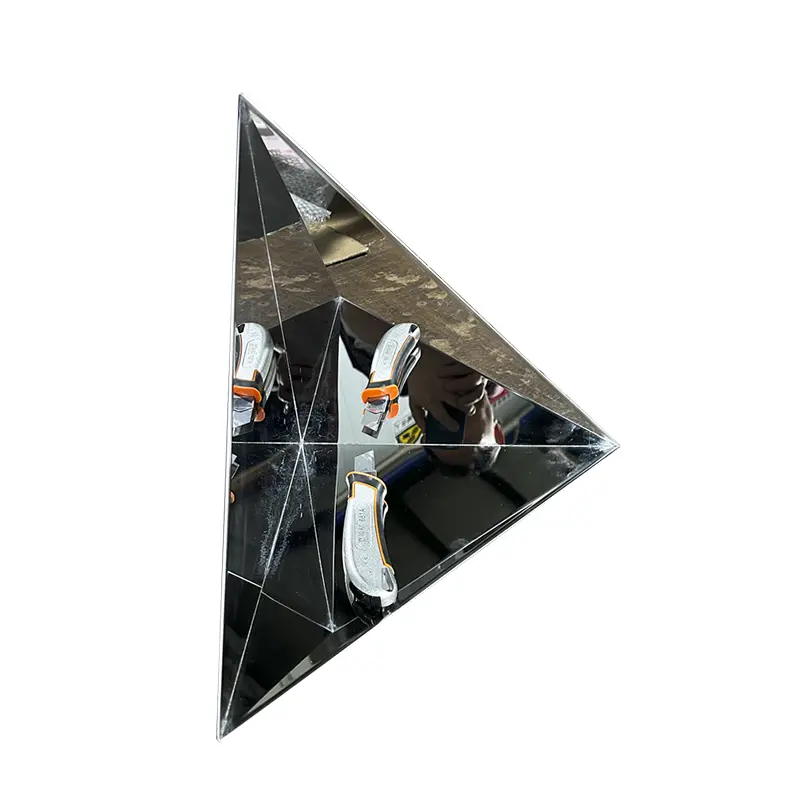
During inspection, the client placed a simple utility knife inside the chamber.
The photograph they captured became the most direct proof of surface quality:
Razor-sharp mirror edges with no trailing
No halos caused by scattered light
No curvature or distortion from surface waviness
True-to-size reflections even after multiple bounces
In other words:
The mirrors are not only flat, but clean.
Not only smooth, but stable.
Not only reflective, but precise.
Why Surface Smoothness Matters: It Determines Signal Purity
Astronomy deals with extremely weak signals.
A slight increase in surface roughness can amplify noise ten-fold or a hundred-fold.
This type of optical structure is used for:
Star sensor calibration
Optical path consistency verification
Laser alignment systems
Terahertz experimental setups
Multi-angle reflection path testing
All these applications require one thing in common:
The reflected signal must remain pure.
And purity begins with the mirror surface.
Precision Defines Geometry. Smoothness Defines Quality.
In this project, THZ Precision did not simply deliver a “mirror structure.”
We delivered:
Optical-grade reflective surfaces
Multi-facet geometry with zero distortion
Experiment-verified stable imaging performance
A component that meets true optical-instrument quality standards
We are not making metal parts.
We are manufacturing optical structures for scientific experimentation.