
The components shown here are 316L stainless steel micro spring–needle assemblies designed for medical devices that interact directly with biological tissue.
Each unit integrates:
A 316L micro compression spring
A fine 316L penetration needle
A 316L base/seat structure
All joined through precision micro-welding
This compact, high-accuracy structure enables controlled penetration, sampling, or micro-delivery in minimally invasive medical systems.
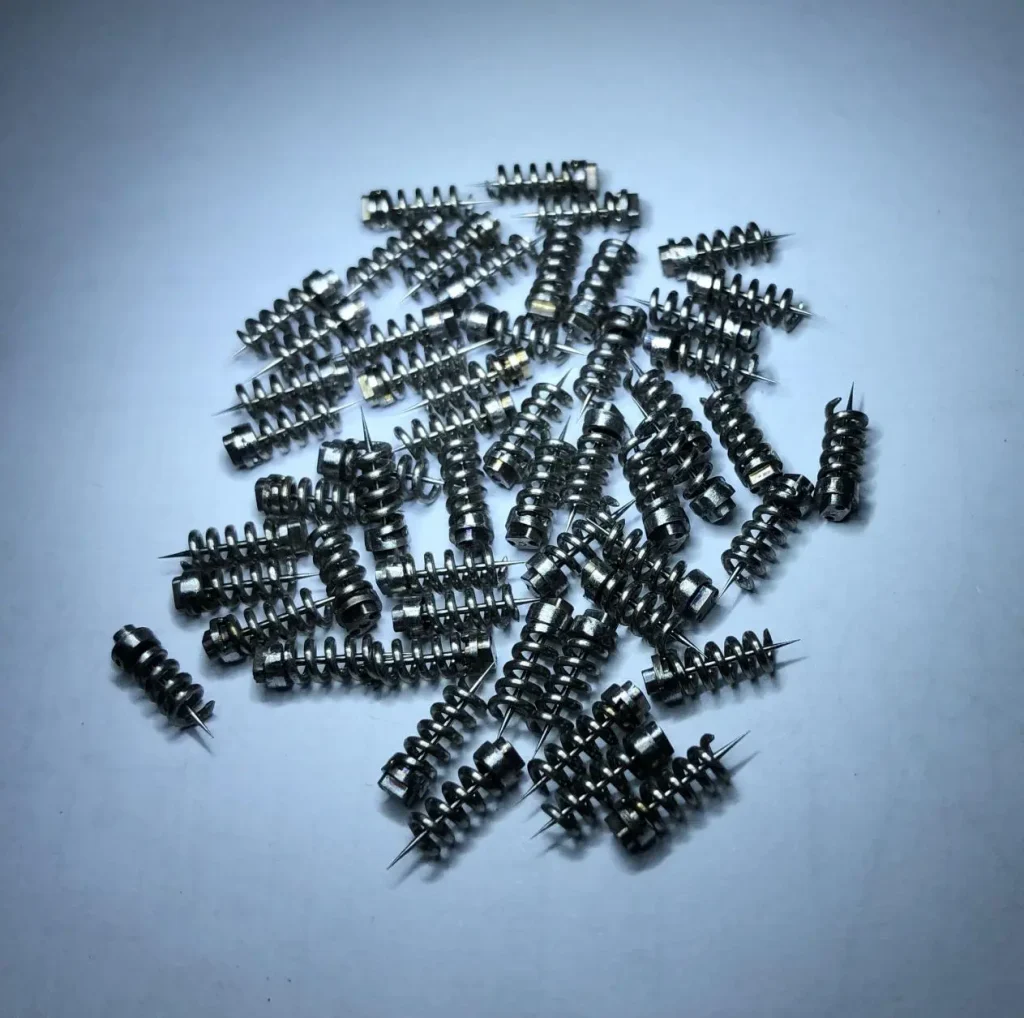
These assemblies are representative of the increasing demands for miniaturized medical components, where reliability, biocompatibility, and dimensional accuracy must all reach surgical-grade consistency.
- Why 316L Stainless Steel is Ideal for Tissue-Contact Components
316L stainless steel is widely used in high-end medical devices due to:
Biocompatibility, safe for direct tissue interaction
Corrosion resistance in saline and bodily fluids
Excellent spring forming and needle drawing properties
Stable mechanical behavior during cyclic loading
Exceptional welding characteristics (low-carbon alloy improves weld quality)
For devices that rely on precise micro-movement and controlled penetration force, 316L is one of the most reliable materials.
- Functional Structure of the Assembly
Micro Compression Spring (316L)
Provides:
Constant axial force
Smooth, controlled actuation
Repeatable penetration depth
Vibration absorption during tissue contact
Micro Needle (316L)
Designed for:
Minimal tissue trauma
High straightness at micro-diameter scale
Burr-free sharp tip geometry
Reliability during thousands of cycles
Base / Seat Structure
Acts as the mechanical interface to the medical device:
Transfers spring force
Provides assembly alignment
Serves as the welding anchor point
Micro-Welded Integration
The spring, needle, and seat are permanently joined via miniature welding techniques such as:
Laser micro-welding
This produces:
Strong, repeatable joints
No adhesive contamination
Perfect axial alignment
Superior durability under repeated use
- Key Applications in Modern Medical Devices
These 316L micro spring–needle assemblies are commonly used in:
Tissue penetration tools
Micro-biopsy instruments
Micro-injection pens and controlled-dose delivery systems
Diagnostic tissue sampling cartridges
Minimally invasive surgical instruments
Micro-actuated valves in fluidic medical devices
Sensor systems requiring direct tissue contact
Their small form factor and precise force control make them ideal for next-generation medical technology where miniaturization and repeatability are essential.
- Engineering Challenges & Our Solutions
Challenge 1 — Ultra-fine needle geometry
Maintaining micro-diameter straightness
Achieving a sharp, burr-free tip
Avoiding bending during assembly
Solution:
Precision cold drawing + multi-stage inspection + micro-fixture welding.
Challenge 2 — Stable micro spring performance
Tight pitch and coil geometry
Force curve consistency
Zero deformation during welding
Solution:
316L custom spring forming + controlled heat input welding.
Challenge 3 — Micro-welding three miniature components
The most critical step requires:
Controlled heat intensity
No annealing of the spring
No warping of the needle
Micron-level positional accuracy
Solution:
Advanced micro-laser welding with 0.01 mm alignment.
Challenge 4 — Medical-grade cleanliness
Devices that contact tissue must:
Avoid particulates
Avoid hydrocarbon contamination
Maintain corrosion-free surfaces
Solution:
Ultrasonic cleaning + passivation + ISO-class packaging.
- What Makes Our Manufacturing Capability Different
We specialize in miniature medical components requiring:
±0.01 mm weld alignment
±0.02–0.05 mm spring free-length tolerance
High-straightness micro needles (micron-level control)
Clean, stable welds that pass repeated sterilization cycles
This enables medical OEMs to move from prototype to mass production without changing processes, ensuring long-term supply consistency.